

Macrotag COMPLY
Audit Preparation & Readiness Enablement
Macrotag COMPLY
Pre-audit simulation
This service structures documentation architecture and evidence preparation before external audit engagement. Activities include documentation review, gap prioritization, simulation-based audit preparation, and executive briefing support to ensure leadership visibility over certification readiness.
The result is a controlled preparation environment where documentation, operational practices, and control evidence are aligned to support efficient certification processes and predictable audit outcomes.

Governance, Risk & Compliance Readiness
Structured GRC Architecture Before Implementation
All engagements begin with a structured diagnostic to define governance maturity and implementation scope. Governance risk architecture, compliance readiness programs, policy framework structuring, and evidence management systems are evaluated before control implementation begins.
The program operates as a compliance architecture service rather than compliance software. It formalizes governance structures and operational accountability across SaaS platforms, digital businesses, and scaling organizations requiring structured regulatory alignment.
Through defined policy structures, risk mapping, and evidence governance models, organizations establish a clear compliance operating framework capable of supporting certification pathways and regulatory oversight.
This structured governance baseline strengthens operational clarity and supports sustainable regulatory alignment as infrastructure and organizational scale increase.

Compliance Posture Assessment & Gap Analysis
Formal Control Maturity & Risk Exposure Evaluation
The engagement begins with a structured evaluation designed to measure compliance readiness. Compliance posture assessment, risk exposure analysis, control maturity evaluation, and policy structure review provide a documented baseline of the organization’s governance environment.
The assessment analyzes policies, system-level control implementation, internal governance roles, and operational procedures. This evaluation identifies alignment gaps between current practices and certification or regulatory expectations.
Findings are consolidated into a documented compliance posture summary supported by a phased implementation roadmap that prioritizes remediation and governance strengthening initiatives.
The structured diagnostic establishes the operational foundation required to implement scalable compliance frameworks while maintaining operational continuity.

EU AI Act Audit & Compliance
Establish full visibility, risk classification, and audit-ready governance across all AI systems
The engagement begins with a structured AI system discovery and compliance audit designed to establish full visibility into all AI usage across the organization. AI inventory creation, system classification, risk exposure mapping, and governance structure evaluation provide a documented baseline aligned with EU AI Act requirements.
The assessment analyzes AI systems embedded in SaaS platforms, internal workflows, and third-party integrations, alongside policy frameworks, data flows, and operational ownership.
This evaluation identifies gaps between current AI usage and regulatory obligations, including undocumented systems, unmanaged risk levels, and missing governance controls.
Findings are consolidated into a comprehensive AI compliance report supported by a phased remediation roadmap that prioritizes system documentation, risk classification, and governance implementation initiatives required for EU AI Act readiness.
This structured approach establishes the operational foundation needed to maintain continuous AI oversight, ensure audit readiness, and enable scalable compliance as AI adoption expands across the organization.

Control Architecture & Framework Alignment
Policy Structures and Certification Framework Integration
Following the diagnostic phase, control structures are aligned with the regulatory frameworks relevant to the organization’s operational environment. Compliance framework alignment, internal control architecture, policy governance models, and access governance structures are implemented to support formal certification readiness.
Framework scope is determined according to organizational scale, technical infrastructure, and regulatory exposure. Controls are harmonized to ensure policies, procedures, and operational practices map correctly to certification requirements such as ISO-aligned, SOC-aligned, or sector-specific standards.
This architecture ensures that internal governance mechanisms operate as an integrated compliance environment rather than isolated policy documents.
The outcome is a structured control ecosystem capable of supporting formal certification audits and long-term regulatory compliance operations.
Client Testimonials

Working with Macrotag gave us a clearer structure around governance and compliance preparation. Their diagnostic helped us understand where our internal controls and documentation needed strengthening before pursuing more formal certification pathways.
Working with Macrotag gave us a clearer structure around governance and compliance preparation. Their diagnostic helped us understand where our internal controls and documentation needed strengthening before pursuing more formal certification pathways.

Macrotag helped us organize our compliance posture in a way that made sense for a growing digital business. The review clarified our governance structure and highlighted several risk and policy gaps we hadn’t formally documented before.
Macrotag helped us organize our compliance posture in a way that made sense for a growing digital business. The review clarified our governance structure and highlighted several risk and policy gaps we hadn’t formally documented before.

As a digital platform operating across multiple systems, we needed clarity on how our governance and operational controls fit together. Macrotag’s GRC diagnostic gave us a structured view of our compliance readiness and what needed attention before scaling further.
As a digital platform operating across multiple systems, we needed clarity on how our governance and operational controls fit together. Macrotag’s GRC diagnostic gave us a structured view of our compliance readiness and what needed attention before scaling further.

Continuous Monitoring & Governance Structuring
Operational Oversight and Compliance Monitoring Architecture
Sustained compliance requires governance visibility beyond initial control implementation. Compliance monitoring frameworks, governance workflow automation, risk oversight structures, and evidence lifecycle management are designed to maintain operational control over compliance activities.
Monitoring logic is structured using the organization’s existing infrastructure and operational tools whenever possible. Governance workflows are implemented to track access control activity, vendor dependencies, policy adherence, and operational risk indicators.
Structured evidence management procedures ensure documentation remains continuously updated and audit-ready.
This monitoring architecture enables organizations to maintain governance accountability while supporting long-term compliance sustainability and operational stability.
GRC Partners









Vendor Risk & Third-Party Governance
Structured Third-Party Risk Evaluation Frameworks
Digital businesses increasingly rely on third-party vendors that influence security posture and regulatory exposure. Vendor risk management frameworks, third-party governance models, supplier risk classification, and contract control requirements are structured to manage external dependency risk.
The service designs vendor evaluation procedures that support defensible compliance practices during external audits. Risk segmentation models classify suppliers according to operational criticality and compliance impact.
Documentation procedures ensure that vendor relationships, security assurances, and contractual obligations remain visible within the organization’s governance framework.
This structured vendor governance architecture strengthens external risk oversight while maintaining compliance defensibility across complex supplier ecosystems.

Access Governance & Internal Control Structuring
Role-Based Access Governance Architecture
Access governance plays a critical role in maintaining defensible compliance environments. Role-based access control models, approval governance workflows, access review frameworks, and control documentation structures are implemented to support internal accountability.
The service formalizes role definitions, approval hierarchies, and periodic review procedures to ensure access privileges remain aligned with operational responsibilities.
Governance documentation frameworks capture access policies, review schedules, and validation procedures required for compliance verification.
This structured access governance environment improves operational transparency while strengthening internal control defensibility during certification audits.

Trust Documentation & External Assurance Readiness
Structured Compliance Communication Infrastructure
Organizations often need to demonstrate compliance posture to enterprise customers, investors, and regulatory stakeholders. Compliance documentation frameworks, control summary architecture, policy indexing structures, and assurance communication templates are implemented to support controlled disclosure.
The service organizes internal compliance documentation into structured formats suitable for external assurance processes and procurement evaluations.
Standardized summaries and policy mapping structures allow organizations to communicate governance maturity while protecting sensitive operational information.
This documentation architecture enables consistent compliance communication and supports enterprise procurement requirements and partnership evaluations.
Structured Compliance
Enterprise Certification Readiness and Governance Continuity
Organizations pursuing recognized security and regulatory standards require structured compliance infrastructure capable of supporting certification and long-term governance operations. Certification readiness architecture, control implementation guidance, risk management frameworks, and audit preparation systems are structured to support this objective.
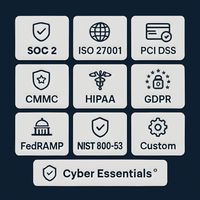
The program supports alignment with widely recognized standards including SOC 2, ISO 27001, PCI DSS, CMMC, HIPAA, GDPR, FedRAMP, NIST frameworks, CIS Controls, Cyber Essentials, and sector-specific regulatory requirements.
Through structured implementation roadmaps and governance oversight models, organizations maintain continuous certification readiness while strengthening operational accountability.
The result is a scalable compliance environment that reduces audit friction, accelerates certification timelines, and strengthens enterprise trust across commercial and regulatory ecosystems.

UP to 50% OFF
Upgrade Your Tier. Unlock Up to 50% Off*
*Terms apply